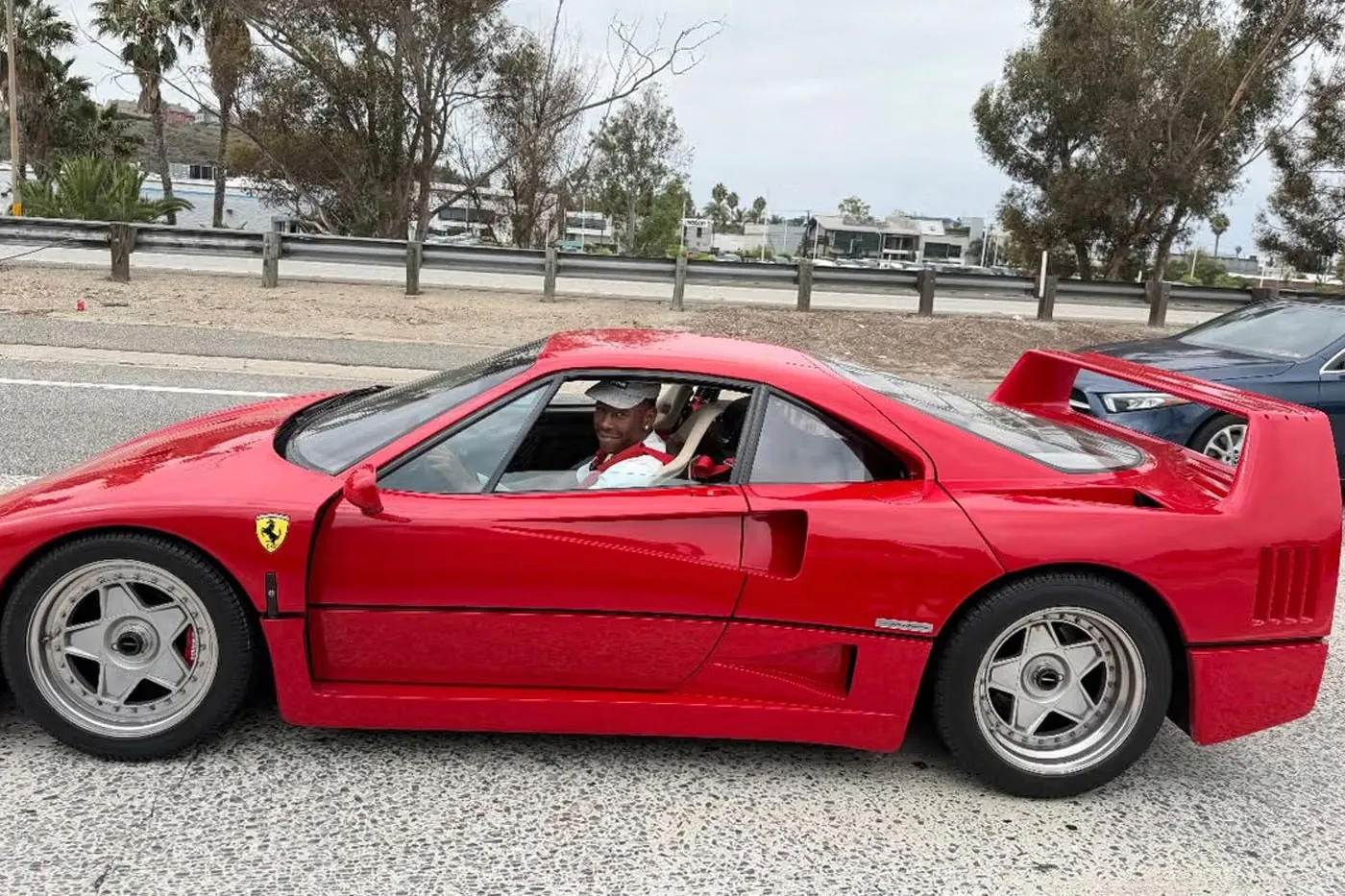
Tyler, the Creator took his love for all things automotive to the next level when he featured his Ferrari F40 in his 2025 “STOP PLAYING WITH ME” music video. But the internet went into a fresh frenzy just yesterday when a viral video captured Pharrell casually driving by Tyler, who was out cruising the streets of LA in that very same iconic supercar. Add in Formula 1 champion Lewis Hamilton recently taking to social media to celebrate finally acquiring one of his own, and it’s clear the F40 is having a major modern moment.
This isn’t just about celebrities buying expensive cars. The Ferrari F40 has transcended the automotive world to become a bona fide cultural phenomenon, a coveted masterpiece for collectors and enthusiasts alike. Its allure has historically captivated a diverse range of high-profile figures, from Sir Rod Stewart—famously the very first owner who audaciously requested his in yellow instead of the factory red—to Mercedes F1 Team CEO Toto Wolff.
So, why the F40? What elevates it above other million-dollar hypercars?
It comes down to raw, uncompromising legacy. The F40 was built to celebrate Ferrari’s 40th anniversary and holds the profound distinction of being the final masterpiece personally approved by company founder Enzo Ferrari before his death in 1988.
It is the ultimate expression of a speed machine, stripped of modern luxuries and electronic safety nets. While today’s million-dollar hypercars are defined by hybrid-electric motors, lightning-fast dual-clutch automatics, and complex traction control systems that flatter the driver, the F40 is a visceral, analog experience in an increasingly digital world.
To understand the F40, you have to understand its extreme commitment to weight reduction and raw feedback. There is no power steering, no power brakes, and absolutely no ABS to save you if you lock up the tires. There are no plush carpets, no stereo system, and not even interior door handles—just a bare wire string you pull to get out.
Compared to its direct 1980s rival, the Porsche 959—which was a technological marvel packed with computers and all-wheel drive—the F40 was violently simple. It was essentially a race car legally allowed on public roads. Behind the driver sits a mid-mounted 2.9-liter twin-turbocharged V8 engine pushing out 471 horsepower and 426 lb-ft of torque. Paired strictly with a heavy, gated 5-speed manual transmission, the F40 was famously the first production car to shatter the 200 mph barrier, topping out at 201 mph. When those twin turbos spool up, the power delivery doesn’t glide—it hits like a sledgehammer, demanding absolute respect and skill from whoever is behind the wheel.
But it is also a certified work of art. Penned by the legendary design house Pininfarina, the F40’s iconic wedge shape, NACA ducts, and massive, imposing rear wing make it one of the most instantly recognizable silhouettes in automotive history. Ferrari was so obsessed with saving weight that the car’s body was constructed entirely of advanced composites like Kevlar, aluminum, and carbon fiber. In fact, the signature Rosso Corsa red paint was applied so thinly to save precious ounces that you can actually see the zigzag weave of the carbon fiber bleeding through the finish under the right light. It tips the scales at a featherlight 2,425 pounds.
With only 1,315 F40s ever made (and a mere 213 reaching the United States), it’s incredibly rare. The F40 isn’t just a car you can simply buy; it’s a piece of automotive history you have the privilege of preserving. It represents the pinnacle of Enzo Ferrari’s vision, a tangible link to the golden era of motorsport, and a symbol of unapologetic, raw performance. That’s why seeing one on the streets of LA today, driven by a modern cultural icon like Tyler, the Creator, feels less like a flex and more like a passing of the torch.